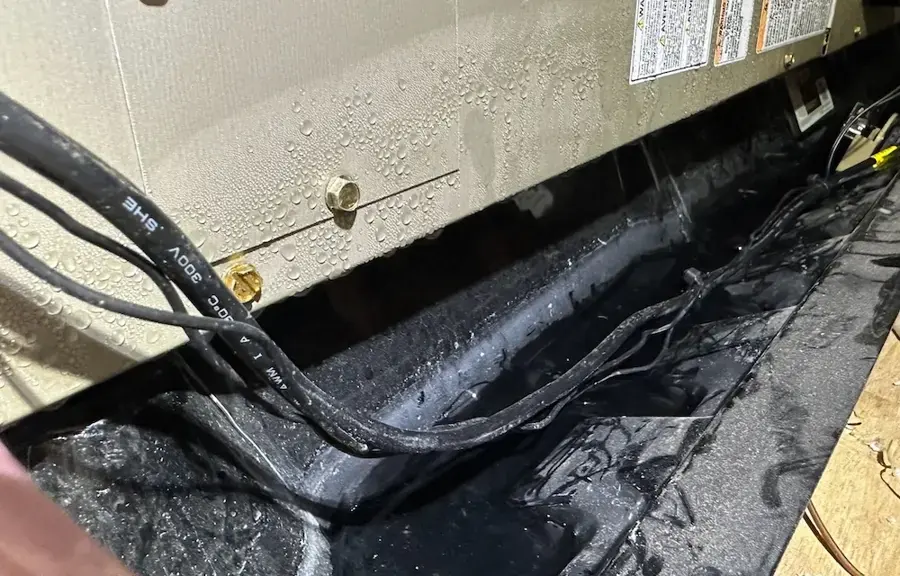
An air conditioner pulls water out of the air all summer, and Prosper has a long cooling season. In many homes the air handler sits in the attic, so a clogged drain sends that water straight into the ceiling below.
Key takeaways
- Prosper has a long cooling season, and many homes put the air handler in the attic.
- A clogged condensate drain or a rusted drain pan leaks straight into the ceiling below the unit.
- The stain often appears in a hallway or bedroom away from the unit, because water follows framing before it drops.
- Turning the system off at the thermostat and the breaker stops new condensate while the leak is dealt with.
- A ceiling that bulges or sags holds water and can fall, so it is treated as unsafe until it is checked.
How an attic air conditioner makes water
As an air conditioner cools the air, it also dries it. The moisture collects as water called condensate, drips into a pan under the unit and leaves the house through a small drain pipe.
Algae and slime can clog that pipe, and an old metal pan can rust through. Either problem sends the water out of the unit and into the attic.
- A clogged condensate drain pipe backs the water up into the pan.
- A rusted or cracked drain pan lets water drop past it.
- A float switch that has failed does not shut the unit off when the pan fills.
- A pan that overflows lands on insulation first and then on the ceiling.
Why Prosper homes see this
A long cooling season keeps air conditioners running and draining for much of the year. In the large one and two story houses common in Prosper, the air handler is often in the attic, which puts the pan and the drain directly over a ceiling.
Some homes also put the water heater in the attic. A second water source in the same space means a leak there can be mistaken for a roof problem.
The ceiling under an attic unit can be a hallway, a closet or a bedroom on the upper floor, so the first sign may be a stain in a room nobody enters often.
Where the water goes from an attic unit
From an attic unit the water passes through three layers in turn.
Attic insulation
Insulation soaks up the water and holds it against the ceiling drywall. Wet insulation is heavy, and it keeps the ceiling wet long after the unit is shut off.
Ceiling drywall
Water softens drywall from above. A brown or yellow stain, a bubble in the paint or a sag in the board are the usual signs.
Walls and the rooms below
Water follows framing, so a stain can appear in a hallway or bedroom well away from the unit. In a two story house the water can keep going into a wall and down toward the floor below.
Water that reaches a recessed light or a ceiling fan is a shock risk, so power to that circuit is switched off at the panel until the area is dry.
AC leak or roof leak: telling them apart
A ceiling stain in Prosper has two common sources: the air conditioner above it, or the roof above that. The pattern of when the stain grows usually points to one or the other.
Both can happen together after a spring storm, so an air conditioning technician and a roofer may both be needed. A hail or wind opening is covered under roof leak water damage.
- An AC leak grows on hot days with no rain, because the unit runs long and makes more condensate.
- A roof leak grows during or right after rain, wind or hail.
- A stain close to the attic unit or its drain outlet points toward the air conditioner.
- A stain near a roof edge, vent or valley points toward the roof.

First steps when a ceiling stain appears
Acting quickly can keep a small leak from turning into a ceiling replacement.
- Turn the air conditioner off at the thermostat and at the breaker.
- Stay out of the attic and out from under a ceiling that bulges or sags.
- Switch off power to any circuit with a wet light or ceiling fan.
- Set a bucket under a drip and move furniture and rugs out of the way.
- Photograph the stain, the drip and the drain pan with the date visible.
- Call an air conditioning technician to clear the drain and a restoration team to dry the ceiling.
How the ceiling and insulation are dried
Ceiling leak water damage work removes what will not dry and dries what will. Sagging drywall and soaked insulation come out, because they hold water against the framing.
Firm drywall that only has a stain can often stay in place while air movers push dry air into the joist bays. Dehumidifiers keep the room air dry so the moisture leaves the materials.
Where the water ran into a cabinet, a wall or a floor, AC and appliance leak water damage work follows it there. Damp materials left in place can start growing mold within 24 to 48 hours, which is why speed matters.
- Soaked insulation is bagged and removed, not dried in place.
- Sagging or soft drywall is cut out in clean sections.
- Joist bays are dried with air movers before any new drywall goes up.
- Readings from the ceiling and the walls below confirm that everything is dry.
What the air conditioning technician does
The technician clears and flushes the drain pipe, checks the pan and tests the safety switch if the system has one. The unit stays off until that work is done.
What the drying team does
The drying team maps the wet area with moisture readings and thermal images, removes what will not dry and sets air movers and dehumidifiers. Structural drying continues until the readings match a dry reference, and only then is the ceiling closed.
Keeping the drain clear and the pan dry
Most overflows are preventable. A technician can flush and treat the drain pipe, check the pan for rust and test the safety switch if the system has one.
A typical attic or cabinet loss from an AC or appliance leak runs about $1,800 to $5,500, and a ceiling that has to be opened runs about $1,800 to $5,000. Prevention is cheaper than either.
- Schedule a drain flush before the cooling season and before a long trip.
- Ask the technician about a float switch that shuts the unit off when the pan fills.
- Check the pan for rust or standing water whenever the unit is serviced.
- Watch ceilings for a faint stain after a run of hot days.
Questions
Why is there a ceiling stain when the roof is fine?
An attic air conditioner makes water of its own. A clogged condensate drain or a rusted pan can leak onto the ceiling on a dry day.
Is AC condensate water clean?
It is not drinking water, and the pan can hold algae and debris. Wet porous materials are handled with care and dried to the dry goal.
Can a wet ceiling fall?
Water that collects above drywall adds weight and softens the board, so the ceiling can sag and fall. A bulging ceiling is treated as unsafe until it is checked.
Should the air conditioner keep running after a leak?
No. Turning it off at the thermostat and the breaker stops new condensate while the drain is cleared.
Does homeowners insurance cover an AC leak?
Coverage depends on the policy and the cause. Many policies cover sudden water damage but may treat slow leaks or missed maintenance differently, so the wording decides.
How often should an AC drain be flushed?
A technician sets the schedule. Flushing before the cooling season and before a long absence is a common routine.